Understanding how does laser hair removal work on dark skin begins with one important fact: the laser sees pigment. Darker skin contains more melanin around each follicle, so treatment requires careful wavelength selection, cooling, and energy control.
The 1064-nanometer Nd:YAG laser is widely regarded as the safer option for Fitzpatrick skin types V and VI. It reaches the follicle while limiting surface-melanin absorption. A 2011 review in the Journal of Clinical and Aesthetic Dermatology identified long-pulsed Nd:YAG technology as particularly useful for darker skin. Grand View Research’s recent market analysis also shows growing demand for professional laser hair-reduction services. Growth does not equal safety.
Dr. Tina Alster, a leading laser dermatologist, explains the principle simply: “The laser targets melanin in the hair follicle.” That target is why coarse, dark hairs usually respond better than fine, light hairs. It also explains why settings cannot be copied from one patient to another. The American Society for Dermatologic Surgery continues to emphasize consultation with qualified medical providers for energy-based procedures. A responsible session may include a test patch, shaved skin, cooling contact, and gradual fluence adjustments. Expect several treatments because hairs grow in cycles. Some redness is common. Blistering is not.
The process is precise, but imperfect. Recent tanning, certain medications, and uneven pigmentation can change the risk. This guide examines the technology, provider experience, realistic results, and safer decision-making for people asking: how does laser hair removal work on dark skin?
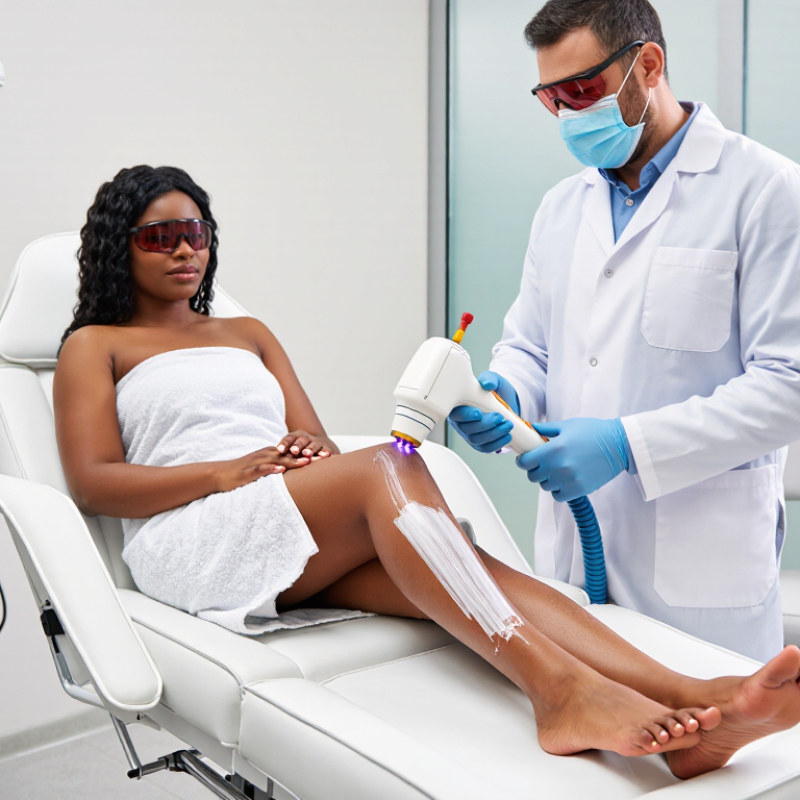
Laser hair removal works through selective photothermolysis. Light enters the skin and is absorbed by melanin inside the hair shaft and follicle. The pigment converts light into heat. This heat damages growth structures while leaving nearby skin relatively unharmed.
Dark hair contains more melanin than gray, blonde, or white hair. That contrast helps the follicle absorb energy efficiently. Dark skin also contains abundant melanin, however. Careless settings can heat the surrounding epidermis and cause burns or temporary pigmentation changes. A 2024 American Academy of Dermatology report notes that patients commonly need multiple treatments, with about 10% to 25% hair reduction after the first session. Results vary by hair thickness, body area, hormones, and growth cycle.
Longer wavelengths, especially near-infrared 1064 nm systems, generally penetrate deeper and reduce surface-melanin absorption. Clinical reviews report safer outcomes for Fitzpatrick skin types IV to VI when providers use conservative fluence, longer pulse durations, cooling, and test spots. The follicle must be warm enough, not scorched. That distinction matters. Treatment should target actively growing hairs, so appointments are usually spaced several weeks apart. Shaving is usually preferred before treatment; waxing removes the target shaft. A test patch remains essential, because published safety data cannot predict every individual reaction. Even careful treatment may produce uneven reduction, and “permanent” rarely means every hair disappears forever.
2026 Best: How Does Laser Hair Removal Work on Dark Skin?
For Fitzpatrick V–VI skin, laser hair removal requires careful wavelength selection. The 1064-nm Nd:YAG laser is often preferred because its longer wavelength penetrates deeper into the dermis. It reaches pigment inside the hair follicle while producing less absorption in the epidermis. This reduces, but does not remove, the risk of burns and pigment changes.
The laser delivers brief pulses of heat to the follicle. Hair growth then becomes slower and finer over several treatment sessions. Black or dark brown hair usually responds best. Gray, white, and very light hair may respond poorly because they contain little usable pigment. In a professional clinic, the practitioner should check skin tone, hair density, recent sun exposure, medications, and previous reactions. A small test patch matters. It may feel like warm pinpricks, followed by temporary redness around each follicle.
Cooling is essential for comfort and epidermal protection. Settings must match the treatment area, hair thickness, and skin response. Too much energy can cause blistering or lasting discoloration. Too little may produce disappointing results. Darker skin can still develop post-inflammatory hyperpigmentation or lighter patches. The process is not perfectly predictable. I would question any promise of permanent, risk-free removal. Experienced clinicians document the skin before treatment and adjust later sessions carefully, rather than repeating identical settings.
Why 1064-nm Nd:YAG lasers are commonly preferred for Fitzpatrick V–VI skin
The chart shows representative fluence ranges reported for common laser hair-removal systems. The 1064-nm Nd:YAG wavelength generally has lower epidermal melanin absorption than shorter wavelengths, allowing energy to reach the hair follicle with a lower risk of unwanted epidermal heating in deeply pigmented skin. Actual settings must be individualized using cooling, test spots, skin assessment, and clinical judgment.
Values are representative clinical ranges rather than universal treatment recommendations; published protocols vary by device, hair thickness, body area, pulse duration, and skin response.
Laser hair removal on dark skin requires controlled heat, not maximum heat. Melanin absorbs laser energy, so the epidermis can overheat before the follicle is damaged. A 2023 systematic review in Lasers in Medical Science found temporary pigment changes were more common in darker skin types, while permanent scarring remained uncommon. Long-pulsed 1064-nanometer Nd:YAG treatment is often preferred for Fitzpatrick skin types IV–VI. Settings still need personal adjustment.
Patch tests matter. A clinician should treat a small area and monitor redness, swelling, blistering, or darkening for several days. I would not call a patch test a guarantee. It only reveals how that skin responds to that setting. The American Academy of Dermatology advises discussing skin type, tanning history, and possible side effects before treatment. Cooling helps protect the surface. Contact cooling, chilled air, or a cooling gel can reduce epidermal heat and discomfort. In practice, insufficient cooling may increase burn risk. Excessive cooling can also reduce treatment effectiveness.
Tips: Avoid tanning before and after sessions. Shave, rather than wax, before treatment. Ask for measured fluence, pulse duration, and spot size. Take photographs in the same lighting. If burning pain continues, stop treatment and seek medical assessment. A cautious clinician may delay treatment. That is good judgment, not failure.
| Treatment Dimension | What Happens on Darker Skin | Safer Clinical Approach | Key Evidence-Based Point |
|---|---|---|---|
| How the laser works | Melanin in the hair absorbs light and converts it into heat, which damages the follicle and reduces future hair growth. | Use a wavelength and pulse settings selected for the individual’s skin tone, hair color, hair thickness, and treatment area. | Laser energy is absorbed by both hair pigment and skin pigment, so darker skin requires careful energy control. |
| Commonly considered wavelength | Longer wavelengths generally penetrate more deeply and may reduce the amount of superficial melanin absorbing the treatment energy. | A 1064 nm Nd:YAG laser is commonly selected for Fitzpatrick skin types V–VI, when clinically appropriate and operated by a qualified professional. | Wavelength alone does not guarantee safety; fluence, pulse duration, spot size, cooling, and technique also affect risk. |
| Patch test | A small test area can reveal excessive pain, blistering, prolonged redness, pigment darkening, or pigment lightening before full treatment. | Test a representative area using conservative settings and observe the skin response before treating a larger area. | A patch test improves risk assessment, but it cannot eliminate the possibility of a delayed reaction or guarantee a complication-free treatment. |
| Expected immediate endpoint | Temporary perifollicular redness or swelling may occur around treated hairs. | The operator should monitor the skin continuously and stop or adjust treatment if there is whitening, gray discoloration, blistering, or severe pain. | Mild, short-lived perifollicular swelling can be expected; blistering or intense persistent pain is not a normal target endpoint. |
| Cooling | Cooling helps reduce heat in the epidermis, which contains more pigment in darker skin, while improving treatment comfort. | Use an appropriate integrated or external cooling method before and during pulses, with careful contact and temperature monitoring. | Cooling can reduce epidermal injury but does not compensate for excessive energy, poor technique, or treatment of recently tanned skin. |
| Burn risk | Excessive epidermal heating may cause burns, crusting, blisters, or prolonged inflammation. | Avoid treating over active irritation, sunburn, open lesions, or recently tanned skin; use test spots and conservative escalation. | Risk rises when the skin has more competing pigment or when energy and cooling are not matched to the patient’s skin response. |
| Post-inflammatory hyperpigmentation (PIH) | Inflammation or thermal injury can stimulate additional melanin production, leaving temporary or persistent darker marks. | Prevent unnecessary inflammation, control heat, protect the area from ultraviolet exposure, and follow individualized aftercare. | PIH is more noticeable and often more prolonged in richly pigmented skin, although it can occur in any skin tone. |
| Hair color and thickness | Coarse, dark hair usually absorbs more laser energy than fine or lightly pigmented hair. | Set expectations for gradual reduction and recognize that blond, gray, white, and red hairs may respond poorly because they contain less suitable pigment. | Laser hair removal provides long-term hair reduction rather than guaranteed permanent removal. |
| Treatment schedule | Only hairs in an active growth phase are most responsive, so multiple sessions are normally needed. | Schedule sessions according to the body area and hair-growth cycle rather than treating too frequently. | Results vary by body area, hormones, hair density, skin tone, and treatment settings. |
| Aftercare warning signs | Increasing pain, spreading redness, blistering, drainage, marked swelling, or rapidly changing pigmentation may indicate a complication. | Contact a qualified medical professional promptly if symptoms worsen or do not improve as expected. | Do not pick crusts or blisters, and avoid additional heat, friction, and unapproved active products until the skin has recovered. |
Safety note: Laser hair removal on dark skin should be performed by a properly trained, qualified professional who can assess skin type, recent tanning, medications, medical conditions, and the risk of pigmentary change. Individual settings and treatment suitability must be determined during an in-person assessment.
Laser hair removal targets melanin inside the hair shaft. The light becomes heat and damages the follicle’s growth structures. Darker skin also contains melanin, so treatment requires careful wavelength selection and conservative settings. For Fitzpatrick skin types IV–VI, long-pulsed 1064 nm Nd:YAG lasers are commonly studied because they reach the follicle with less surface absorption. Cooling and a test spot remain essential.
Clinical data after six to eight sessions usually show meaningful hair reduction, not complete removal. Across published studies, reductions often range from 50% to 80%, depending on hair thickness, body area, hormones, and follow-up timing. Coarse underarm or bikini hair may respond better than fine facial hair. Sessions are spaced several weeks apart because lasers affect hairs during active growth. Some participants need maintenance treatments later.
Results are not perfectly predictable. This matters. Temporary redness and swelling can occur, while darker skin faces higher risks of burns, post-inflammatory hyperpigmentation, or light spots when settings are too aggressive. A qualified medical provider should assess skin tone, recent tanning, medications, and scar history. Photographs and hair counts are more reliable than memory alone. Even then, small studies and inconsistent follow-up weaken some conclusions. A cautious plan may feel slower, but it helps protect the skin while building measurable progress.
Laser hair removal on dark skin requires careful control, not simply stronger energy. Melanin absorbs light in both skin and hair. A qualified clinician may choose longer wavelengths, conservative settings, and steady cooling. A test patch can reveal irritation or excessive heat before a full session. In practice, results often appear gradually. Results vary. Coarse, dark hairs usually respond more clearly than fine or light hairs.
After long-term hair reduction, maintenance treatments remain normal. Laser targets hairs during active growth, but follicles enter different phases. New cycles can bring scattered hairs back months later. Hormonal changes may also stimulate new growth. Maintenance may involve occasional sessions based on visible regrowth, rather than a rigid calendar. Do not chase every hair immediately. The skin needs time to settle.
A practical plan includes photographs, treatment records, and honest reviews of skin reactions. Persistent redness, blistering, or pigment changes require medical assessment. Sun exposure can increase risk, so broad-spectrum sunscreen and careful aftercare matter. One limitation deserves honesty: no responsible provider can promise permanent removal. Long-term reduction is more realistic. Some people need fewer sessions, while others need ongoing care. The schedule is not perfectly predictable. That uncertainty should be discussed before treatment, not hidden afterward.
Melanin in dark hair absorbs the light. The pigment changes light into heat. That heat damages growth structures inside the follicle. Nearby skin may remain safer when settings are carefully controlled.
Dark hair contains more melanin than gray, blonde, or white hair. This creates stronger contrast with the surrounding skin. The follicle can absorb energy more efficiently. Results still vary.
It can be, but settings require careful adjustment. Dark skin contains more surface melanin, which can also absorb energy. Excess heat may cause burns or temporary darkening. Caution matters.
Longer wavelengths, such as 1064 nanometers, generally reach deeper skin layers. They may reduce energy absorption by surface melanin. Conservative energy, longer pulses, cooling, and test spots remain important.
A clinician treats a small area first. The skin is observed for redness, swelling, blistering, or darkening. This shows how that skin responds to one setting. It is not a guarantee.
Contact cooling, chilled air, or cooling gel can lower surface heat. It may also reduce discomfort. Insufficient cooling can increase burn risk. Excessive cooling may reduce effectiveness.
Shaving is usually preferred before treatment. Waxing removes the hair shaft that absorbs the energy. Avoid tanning before and after sessions. Bring up recent tanning during consultation.
Multiple sessions are commonly necessary because hair grows in cycles. Appointments are often separated by several weeks. The first session may reduce hair by roughly 10% to 25%. Results are uneven sometimes.
Usually, no. “Permanent” rarely means every hair disappears forever. Hormones, hair thickness, body area, and growth cycles affect results. Some hairs may return or need maintenance treatment.
Stop treatment and seek medical assessment. Continuing through strong burning pain is not a good test of effectiveness. A cautious clinician may delay treatment. That is good judgment, not failure.
How does laser hair removal work on dark skin? It uses controlled light energy to target melanin in the hair shaft and follicle, heating the growth center while aiming to protect the surrounding skin. For Fitzpatrick V–VI skin tones, 1064-nm Nd:YAG technology is generally preferred because its longer wavelength penetrates deeply with less absorption by surface melanin. A qualified professional should perform a patch test first, adjust the energy carefully, and use effective cooling to reduce the risk of burns, irritation, and post-inflammatory hyperpigmentation.
After approximately six to eight sessions, many people with dark skin experience noticeable, long-term hair reduction, although results vary according to hair color, thickness, hormonal factors, and treatment consistency. Laser treatment usually reduces growth rather than guaranteeing permanent removal. Some follicles may become active again over time, so occasional maintenance sessions can help preserve smoother results. Proper aftercare and professional monitoring remain essential throughout the process.
